
CrossFit has revolutionized the fitness industry by making high-intensity functional movements accessible to the general public. While the community atmosphere and the "Work out of the Day" (WOD) format drive incredible results in strength and cardiovascular health, the complexity of the movements introduces a significant risk profile. Athletes often transition from sedentary lifestyles to performing Olympic lifts, high-rep gymnastics, and explosive plyometrics. Without a foundational understanding of spinal mechanics and shoulder stability, the path to peak performance can quickly lead to the treatment room.
At Dynamic Spine and Performance Center, our clinical focus often involves rehabilitating "The Box" regulars who have pushed their limits past their current structural capacity. Protecting the spine and shoulders is not merely about avoiding pain; it is about ensuring long-term athletic longevity and maximizing power output through proper alignment.
The Biomechanics of the Spine Under Load
The spine is designed to handle immense vertical loads, but it is notoriously vulnerable to shear forces: the kind that occur when the spine rounds or twists under weight. In CrossFit, movements like the deadlift, clean and jerk, and the snatch require what is known as a "neutral spine." This position allows the vertebrae to stack efficiently, distributing weight across the intervertebral discs and utilizing the large muscle groups of the posterior chain.
A common error seen in many boxes is the "lumbar flexion" or rounding of the lower back during heavy pulls. When the back rounds, the load shifts from the muscles (the glutes, hamstrings, and erectors) to the passive structures like ligaments and discs. This is a primary driver for sports injuries that require treatment. Conversely, "lumbar extension": or an excessive arching of the back: is frequently seen during overhead presses. This "banana back" posture compresses the facet joints of the spine and indicates a lack of core bracing or limited shoulder mobility.

The Vulnerability of the Shoulder Complex
The shoulder is the most mobile joint in the human body, which unfortunately makes it one of the least stable. CrossFit demands that the shoulder perform at extreme ranges of motion, often under high fatigue. Exercises such as kipping pull-ups, muscle-ups, and snatches require the scapula (shoulder blade) to move in perfect synchronization with the humerus (arm bone).
When an athlete lacks thoracic spine (mid-back) mobility, the shoulder is forced to overcompensate to reach a full overhead position. This leads to impingement syndromes, rotator cuff strains, and labral tears. Research published in the Journal of Strength and Conditioning Research suggests that shoulder injuries are among the most prevalent in high-intensity functional training, often stemming from poor eccentric control: the ability to lower a weight or your own body weight with stability and tension.
7 Ways to Protect Your Spine and Shoulders
To stay in the game and out of the clinic, athletes must prioritize mechanics over intensity. Here are seven actionable strategies to implement at the box tomorrow.
1. Master the "Ribs-Down" Bracing Technique
One of the most effective ways to protect the lumbar spine during heavy lifting is to maintain a neutral ribcage position. Many athletes "flare" their ribs when lifting overhead or squatting, which breaks the connection between the pelvis and the upper body. By keeping the ribs tucked down and engaging the abdominals (a technique often called the "hollow body" position in gymnastics), you create a rigid cylinder of stability. This protects the spine and allows for better force transfer from the ground to the barbell.
2. Prioritize Thoracic Mobility
If your mid-back is stiff, your shoulders and lower back will pay the price. Before any overhead WOD, spend five minutes on thoracic extension and rotation drills. Using a foam roller to gently mobilize the upper back can improve your ability to reach a true "overhead" position without arching your lower back. Improving this mobility is a cornerstone of sports performance chiropractic.
3. Strengthen the Scapular Stabilizers
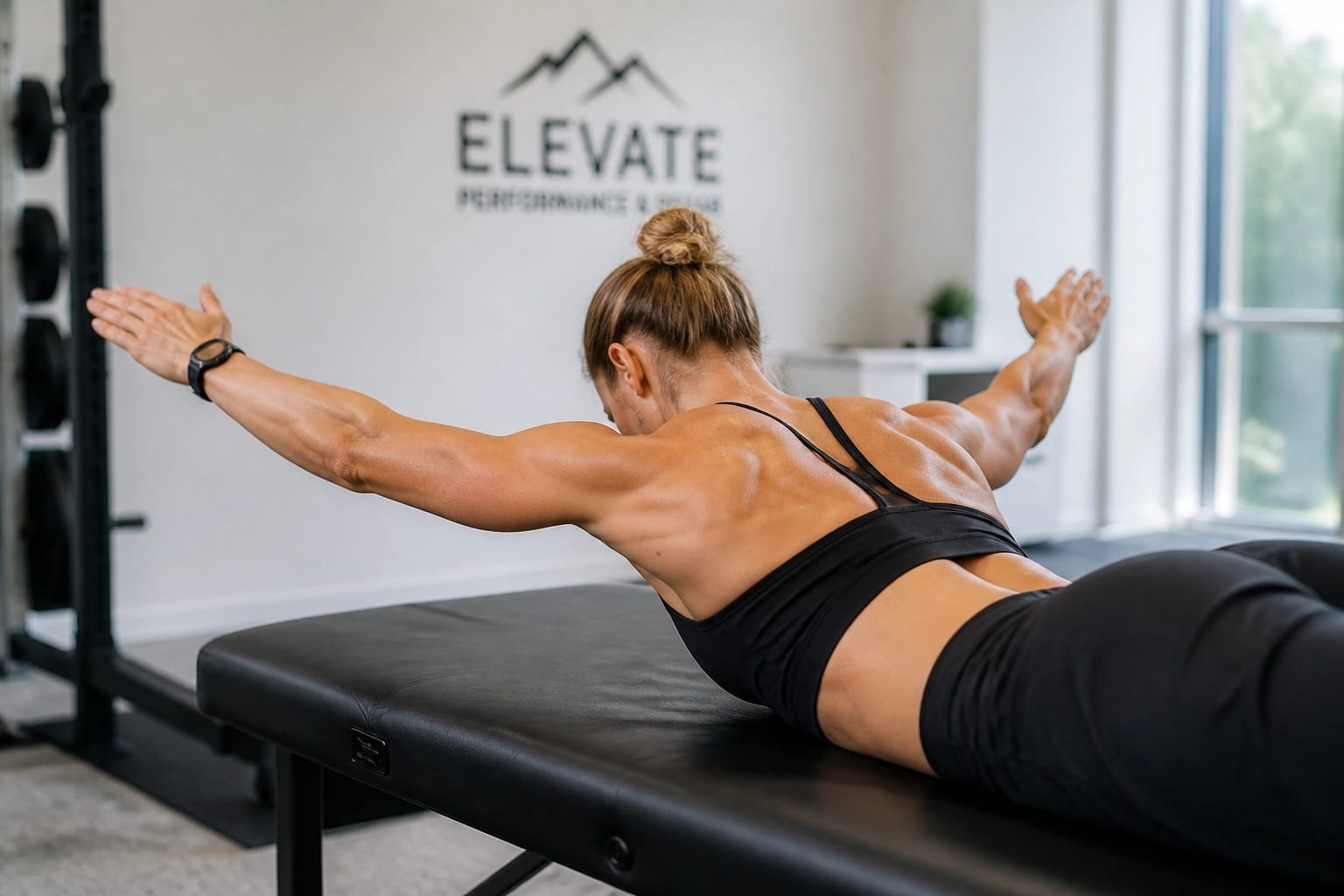
Most CrossFitters focus on the "show" muscles: the deltoids and pectorals. However, the "go" muscles are the serratus anterior and the lower trapezius, which stabilize the shoulder blade. Incorporating "Crossover Symmetry" drills or simple "Y-W-T" floor raises into your warm-up can wake up these stabilizers. A stable scapula provides a solid foundation for the rotator cuff to function, drastically reducing the risk of impingement.
4. Respect the "Hinge"
The hip hinge is the most fundamental movement in strength training, yet it is frequently performed incorrectly. Whether you are doing a kettlebell swing or a heavy deadlift, the movement must come from the hips moving backward, not the spine bending forward. If you cannot maintain a flat back during a pull, the weight is too heavy, or your hamstrings are too tight. Scaling the movement or using blocks to raise the barbell can prevent a catastrophic disc injury.
5. Incorporate Tempo and Eccentric Work
Injury often occurs during the "lowering" phase of a lift or the "drop" in a pull-up when control is lost. By adding "tempo" training: taking 3–5 seconds to lower the weight: you build structural integrity in the tendons and ligaments. This slow, controlled movement teaches the nervous system how to stabilize the joint throughout the entire range of motion, which is essential for sports injury therapy and rehab.
6. Utilize Professional Movement Screening
Sometimes, the limiting factor isn't your effort; it's a structural imbalance you can't see. Periodic check-ups with a specialist can identify early warning signs of a sports injury before they become debilitating. Diagnostic tools and movement assessments can pinpoint whether your shoulder pain is a mobility issue or a stability issue, allowing for a more targeted approach to your training.
7. Implement High-Tech Recovery Tools
When inflammation strikes or a muscle feels "off," traditional rest is often insufficient for the high-level athlete. Techniques like ARP Wave Therapy use bio-electrical currents to find the neurological origin of the pain, often located far from where the actual pain is felt. By treating the source of the compensatory movement, athletes can recover faster and return to the box with a more resilient body.

The Role of Chiropractic Care in CrossFit
Chiropractic care is often misunderstood as merely "cracking backs." In the context of CrossFit, it is a sophisticated tool for neurological and mechanical optimization. Chiropractic adjustments ensure that the joints of the spine and extremities are moving through their full, intended range of motion. When a joint is restricted, the surrounding muscles must work harder to compensate, leading to premature fatigue and injury.
Regular care helps maintain the "joint position sense" (proprioception), which is critical when you are catching a 200-pound barbell overhead. If your brain doesn't have an accurate map of where your joints are in space, your risk of a "missed" lift or an injury sky-rockets. Athletes who integrate regular adjustments often report smoother movement patterns and faster recovery times between high-volume sessions.
Closing the Gap Between Rehab and Performance
CrossFit is a powerful tool for building a fit, capable body, but it demands respect for human anatomy. By focusing on form, mobility, and spinal alignment, you can enjoy the benefits of "the box" without the frequent setbacks of injury. If you find yourself struggling with persistent shoulder "niggles" or a lower back that feels "tight" after every squat session, it may be time to seek a professional evaluation.
At Dynamic Spine and Performance Center, we specialize in helping athletes bridge the gap between injury and peak performance. Whether through manual adjustments, dry needling, or advanced therapies like the ARP Wave, our goal is to get you back to your WODs stronger than before. You can learn more about our specific approach and meet our owner, Dr. Stephen Ford, to see how we can support your athletic journey.

If you are ready to stop training through pain and start training for longevity, you should consider a consultation to ensure your foundation is as strong as your spirit.
Ready to Move, Recover and Perform Better?
Schedule an individualized consultation with Dr. Stephen Ford at one of DSPC’s Greater Houston locations.
Book an Appointment