
Are you hitting a wall with your horse’s progress? Maybe your lead changes have become sloppy, or perhaps that once-reliable jump is suddenly ending in a refusal. When you’ve checked your tack, your bit, and your own seat, and things still aren’t clicking, it’s time to look deeper into your horse’s biomechanics.
At Dynamic Spine and Performance Center, we see performance athletes of all kinds: both human and equine. If you are a rider in Houston or Katy, Texas, you know that training a performance horse is an investment of time, emotion, and resources. Integrating equine chiropractic care isn't just about fixing a "sore back"; it’s about fundamentally changing how you approach your horse's development.
Are You Ignoring the "Early Warning Signs" of a Blocked Athlete?
Think about the last time you felt a "crick" in your neck. You could still walk and talk, but were you ready to go out and run a sprint or perform a complex dance routine? Probably not. Your horse feels the same way.
Performance horses are elite athletes, and they communicate discomfort through their behavior and movement. If you’re noticing any of the following, your training might be fighting against a physical restriction:
- Refusal to take a specific lead or frequent "cross-firing."
- Stiffness when bending in one direction.
- A sudden "bad attitude" or pinning ears when being saddled.
- Difficulty engaging the hindquarters or a lack of "topline" development.
- Shortened stride length that doesn't improve with warming up.
These aren't necessarily signs of a "bad horse" or a lack of training; they are often the early warning signs of a sports injury or a subluxation (a joint that isn't moving correctly). By addressing these with chiropractic care, you stop training around a problem and start training with a healthy body.

Why Does Spinal Alignment Matter for Your Horse’s Training?
You might wonder, "How does clicking a joint back into place help my horse jump higher?" It’s all about the nervous system. The spine protects the spinal cord, which is the "information highway" for your horse’s entire body.
When a joint in the spine or pelvis is restricted, it doesn't just hurt: it muffles the signals between the brain and the muscles. This leads to poor coordination and compensatory movement patterns.
By utilizing chiropractic adjustments, we restore proper motion to those joints. This allows the nervous system to fire correctly. When your horse can actually feel where its legs are in space and move its joints through their full range of motion, your training sessions become significantly more productive. You’ll spend less time fighting resistance and more time refining the movements you actually want to see.
How Does Chiropractic Care Shift Your Training from Reactive to Proactive?
Most riders call a chiropractor only when their horse is "off" or lame. But the real magic happens when you use equine chiropractic as a proactive training tool.
Imagine if you could catch a minor pelvic tilt before it turned into a hock injury. Or what if you could resolve a neck restriction before it caused your horse to start "hollow-backing" under the saddle?
Regular care at Dynamic Spine and Performance Center helps maintain structural integrity. This allows you to push your training goals safely. Instead of waiting for a breakdown that puts your horse in the stall for six months, you’re making small, incremental adjustments that keep them in the arena. It changes your mindset from "recovery" to "optimization."

Can This Improve Your Horse’s Mental Game?
We’ve all been there: you’re trying to work on a specific lateral move, and your horse is getting frustrated, swishing its tail, or even bucking. If your horse is experiencing chronic back pain or joint stiffness, training becomes a source of stress rather than a partnership.
Addressing discomfort through animal and equine chiropractic has a massive impact on a horse's mental state. When a horse moves without pain, they are more relaxed, more focused, and more willing to please.
Think about how much faster your training would progress if your horse wasn't distracted by a "pinched" feeling in their back. You’ll find that "behavioral issues" often disappear once the physical discomfort is resolved.
What Practical Scenarios Show the Biggest Impact?
The benefits of equine chiropractic aren't just theoretical. They show up differently depending on your discipline:
- Dressage: You’ll notice improved lateral flexibility and a more consistent "on the bit" frame. When the poll and neck are adjusted, the horse can stretch into the contact without resistance.
- Jumping: Better "snap" in the front end and more power coming from the hindquarters. A mobile spine allows for a better bascule over the fence.
- Barrel Racing/Speed Events: Improved "turning" ability. If a horse can’t flex its spine through a tight turn, it loses precious seconds.
- Western Pleasure: A more consistent, level topline and a slower, more rhythmic gait that doesn't look "forced."
Are You Forgetting the Other Half of the Equation?
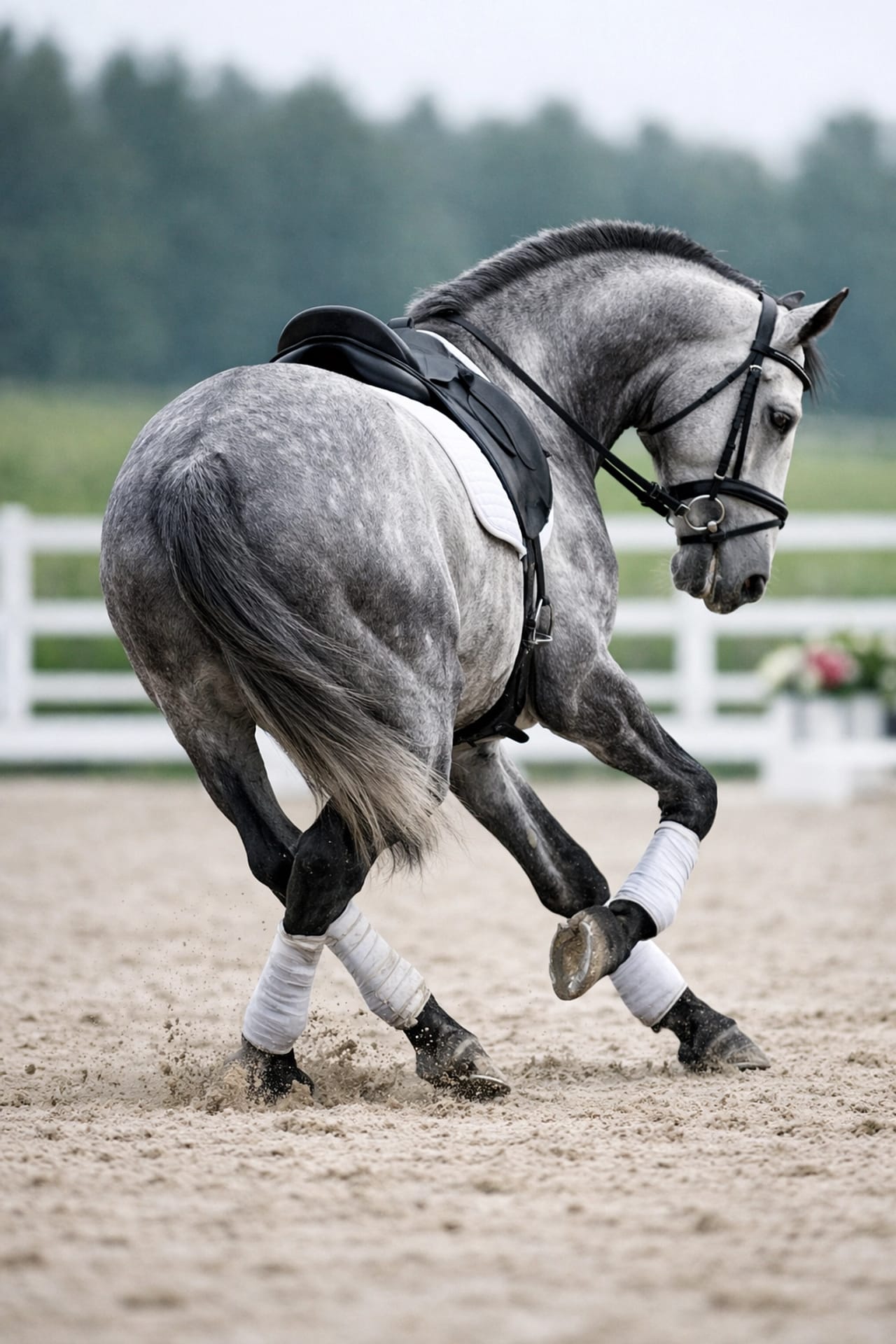
Here is a hard truth: if your horse is crooked, it might be because you are crooked. As a rider, your biomechanics directly impact your horse’s performance. If you have a locked hip or a shifted pelvis, your horse will compensate for your imbalance every single stride.
That’s why at Dynamic Spine and Performance Center, we don't just look at the horse. We look at the team. While we offer world-class animal chiropractic benefits, we also specialize in treating the human athlete.
We often integrate advanced technologies like ARP Wave Therapy to help riders recover from their own injuries or imbalances. If you want your horse to perform at its peak, you need to make sure your body isn't the thing holding them back.

What Should You Expect During a Session?
If you’ve never seen an equine adjustment, it might seem a bit intimidating. But it’s a very controlled, precise process. Here’s what it typically looks like when you work with an expert like Dr. Ford:
- Gait Analysis: We watch your horse move to see where the restrictions are manifesting.
- Palpation: We feel for heat, swelling, and "stuck" joints along the spine, pelvis, and limbs.
- Adjustment: Using high-velocity, low-amplitude thrusts, we restore motion to the restricted joints.
- Post-Check: We re-evaluate the movement to ensure the horse is moving more freely.
Most owners report seeing a visible difference in their horse's comfort levels within days. Some horses even show a "release" immediately after an adjustment: yawning, licking their lips, or taking a deep, relaxing breath.
How Often Does Your Horse Need an Adjustment?
There is no one-size-fits-all answer here. A horse in heavy competition might benefit from a check-up every 4–6 weeks, while a pleasure horse might only need a seasonal tune-up.
The goal is to find a rhythm that supports your training schedule. If you have a big show coming up in Katy or the greater Houston area, scheduling an adjustment 7–10 days before the event can give your horse time to "process" the new movement and enter the ring feeling its best.
Ready to Level Up Your Training?
If you’re tired of hitting the same roadblocks in your training, it’s time to stop guessing and start addressing the root cause. Equine chiropractic care is a game-changer for anyone serious about sports performance.
Don't wait until your horse is visibly lame. Be the proactive owner your horse deserves. Whether you’re dealing with a specific sports injury or you just want to reach that next level of performance, our team is here to help.
Take the next step in your horse's training journey. Reach out to us at Dynamic Spine and Performance Center today to discuss how we can support your equine athlete. Your horse will thank you with better movement, a better attitude, and better results in the arena.
Ready to Move, Recover and Perform Better?
Schedule an individualized consultation with Dr. Stephen Ford at one of DSPC’s Greater Houston locations.
Book an Appointment